Publish date: 19 May 2026
Read in: 9 min
There are places in the world where people live longer, healthier lives and are more likely to reach their 100th birthday – without being obsessed with diets, supplements or complicated exercise regimens. These are the so-called Blue Zones, regions where longevity is part of everyday life. What do the locals eat, how do they relax, how do they build relationships, and what can we learn from them? Read the article and find out why Sopot has the potential to become one such place.
Contents
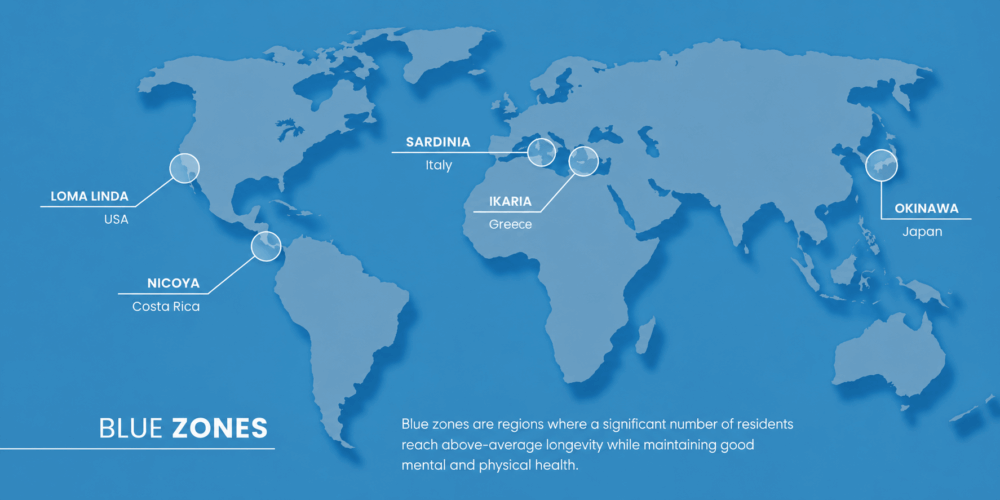
The term ‘blue zones’ was popularised by researcher Dan Buettner, who, together with his team, analysed regions of the world where an exceptionally high number of people live to the ages of 90 and 100 in good health. While working on the map, the researchers marked these places in blue – hence the name.
The concept of Blue Zones is based on the observation that longevity is not solely down to genes, but also to daily habits and the living environment. Common characteristics of the inhabitants of these regions include natural physical activity, a simple diet based mainly on plant-based foods, strong social ties, a sense of purpose, regular rest and a lifestyle that promotes lower levels of chronic stress.
Five regions are recognised as classic Blue Zones:
Each has its own culture, cuisine and way of life, but they share a common thread – a daily routine that naturally promotes good health.
The inhabitants of the Blue Zones do not have a single recipe for longevity – it is the result of daily choices that support health and a good quality of life. Their diet is based mainly on simple, seasonal and minimally processed foods, such as vegetables, fruit, pulses, whole grains, nuts and olive oil. Equally important is natural movement as part of the daily routine – walks, gardening or getting about on foot. Close relationships, rest, rituals and a sense of purpose are also of great importance, helping people not only to live longer, but also, above all, to live better.
In Okinawa, Japan, older residents eat a simple, plant-based diet: sweet potatoes, tofu, lightly stir-fried vegetables, bitter gourd, soya, turmeric and herbs. Meat, including pork, is not a staple of the daily diet – it is more commonly eaten on special occasions and during celebrations. An important principle there is also hara hachi bu, which means finishing a meal before feeling completely full. Daily exercise does not involve working out at the gym, but stems from work around the house, tending the garden, walking and staying active despite one’s age.
In Sardinia, particularly in the mountainous regions, the traditional way of life is linked to the work of shepherds and farmers. Men walk many kilometres a day, traversing hilly terrain. Their diet is dominated by wholemeal bread, beans, chickpeas, vegetables, fruit, olive oil, minestrone-style soups, and small amounts of pecorino cheese made from sheep’s or goat’s milk. Meat is more of a treat for Sundays or special occasions rather than an everyday main course.
On Ikaria in Greece, the diet closely resembles the traditional Mediterranean diet: it is rich in vegetables, wild herbs, beans, lentils, potatoes, whole grains, olive oil, fruit and local herbal infusions. Fish, dairy products and meat are included, but in moderate quantities. The rhythm of the day is of great importance – the locals walk across the mountainous terrain, work in their gardens, prepare food at home, and find time during the day for rest, socialising and a nap. It is a lifestyle in which physical activity stems from daily chores rather than an imposed training regimen.
On the Nicoya Peninsula in Costa Rica, the basis of traditional cuisine is the so-called ‘three sisters’: maize, beans and squash. Added to this are maize tortillas, rice, local tropical fruits, vegetables from their own gardens and simple home-cooked meals. Many older residents have spent their whole lives doing physical work – in agriculture, around the house, in gardens, with animals or within local communities. Daily life therefore involved regular, moderate physical activity: walking, carrying, bending down, farm work and spending time outdoors.
In Loma Linda, California, longevity is primarily linked to the lifestyle of the Seventh-day Adventist community. Many of them follow a vegetarian diet or severely limit their meat intake. Their daily diet includes vegetables, fruit, whole grains, pulses, nuts, tomatoes and plenty of water. It is common practice to eat a larger breakfast and a lighter, earlier dinner. Regular, moderate exercise is also important – walks, housework and natural activity throughout the day, as well as community involvement, volunteering, community gatherings and family rest on the Sabbath.
At NAMI, we combine diagnostics, medicine and regeneration to promote longevity in practice – not just in theory.
In Poland, there is no officially recognised Blue Zone in the traditional sense of the term. This does not mean, however, that there are no places with characteristics conducive to healthy ageing. One such place is Sopot – a spa town situated between the Baltic Sea and the greenery of the Tri-City Landscape Park.
Sopot naturally encourages physical activity, walks, contact with nature and a more relaxed daily rhythm. The proximity of the sea, fresh air, space for regeneration and access to medical care create conditions that can support prevention, well-being and conscious health management. In this sense, Sopot can be seen as a place where the idea of Blue Zones takes on a local, Polish dimension.
You don’t have to live in Okinawa or Sardinia to benefit from the philosophy of longevity. You can start closer to home – in a place that encourages regeneration and mindful self-care.
It was in this spirit that the NAMI Medical Resort and Clinic in Sopot was established. It is a space where holistic medicine, preventative care, rest and contact with nature come together to form a cohesive experience. A stay at NAMI is not just a holiday – it involves following a medical programme tailored to the body’s needs.
Being close to the sea, Sopot’s spa town character and architecture designed with regeneration in mind create the conditions in which it is easier to slow down, regain energy and better understand your body.
We invite you to NAMI – your personal zone of longevity by the Polish seaside.
NAMI Medical Resort and Clinic exclusively offers medical programs.
Give yourself the chance to reset your nervous system, boost your metabolism and strengthen your immune system.
Read more